
Calculus Cases: the professor's trial
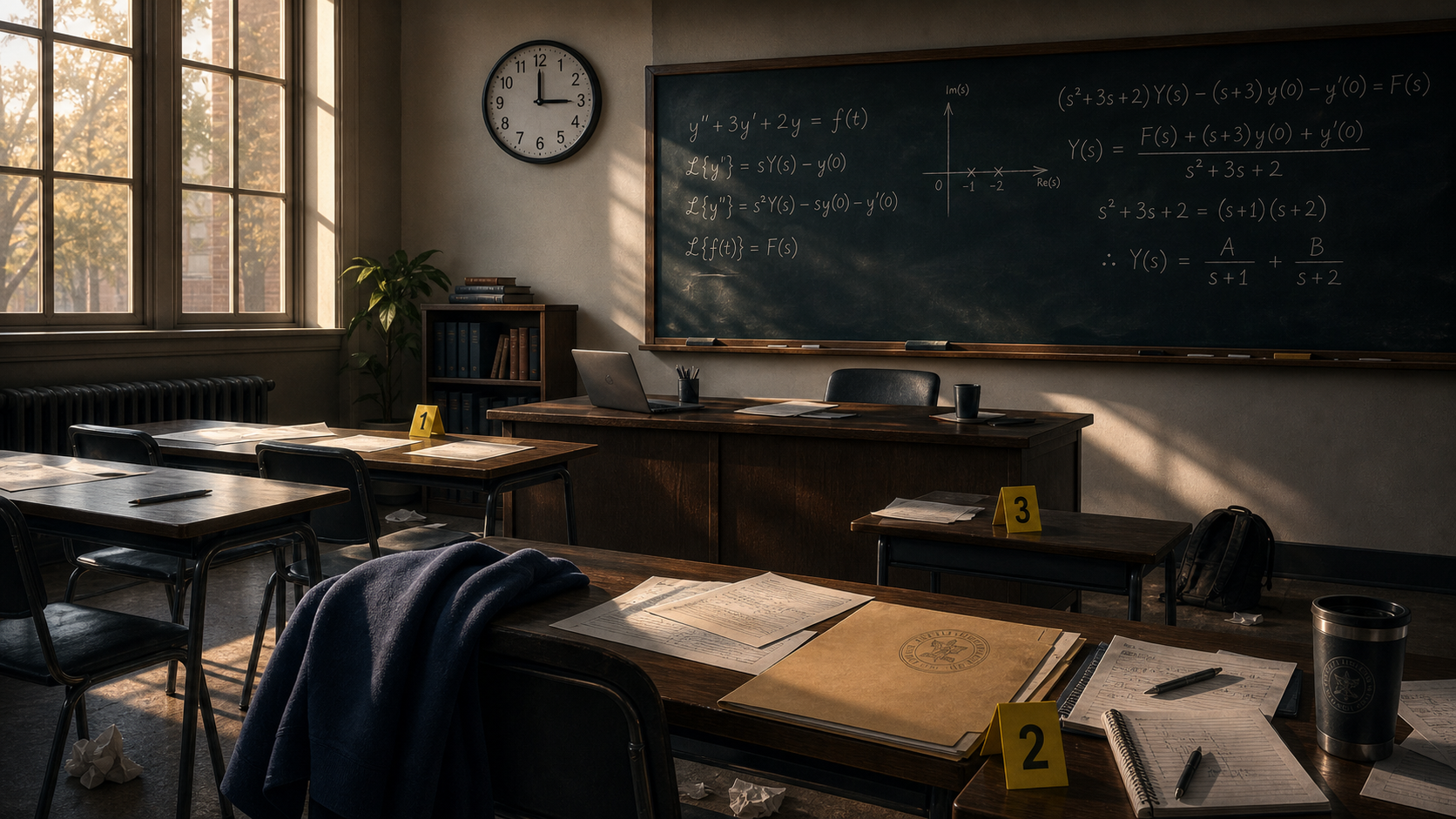
The professor of the course is found dead in his classroom shortly after the end of class, and the case is settled at a trial. The students share out the roles of judge, prosecution, forensic doctor, building custodian, three suspects and jury, each with its own packet of documents and without knowing what the others know. The centrepiece is mathematical: two temperature readings and Newton’s law of cooling give an estimate of the time of death, and that time has to be set against the classroom plan, the building records and the testimony until the court reaches a verdict.
The case follows the format of every Calculus Case: it is launched at the end of a class, prepared in class and at home, and the trial is held in the next class.
- Launch, at the end of a class (15–20 min). You project the presentation: the story, the discovery, the question for the court, the roles and their assignment in your class. The material is printed by group: one packet per role and court. The judge, the custodian and each suspect receive their own (the suspects, in a sealed envelope); the prosecution, the forensic doctors and the jury are teams and share one, kept by one of their members.
- Preparation, in class and at home (30–45 min). Each role prepares its contribution with its own documents only, and the teams prepare together: the forensic doctor and the prosecution, the calculation of the time of death; the custodian, the records; each suspect, their account. Only the forensic doctor, the prosecution and the judge know the estimated time of death; the jury, the custodian and the suspects discover it at the trial.
- The trial, in the next class (60 min). With no pooling beforehand: opening, the forensic report with a pause in which the whole court checks the calculation, the custodian’s and the suspects’ testimony, the closing statement, the jury’s written verdict and the close, with an individual check that is projected and answered on a blank sheet.
Materials generator
The configurator guides you in four steps. The only essential input is the number of students: from it, the website assigns the roles, decides whether more than one court is needed and works out exactly how many copies to print: one per role and court, not one per student. Everything else already has a recommended value.
Activity documents
Start with the printing and distribution guide: it says what to print, how, how many copies and when each document is handed out. The packets tab has one PDF per role, printed once per role and court (teams share theirs); the separate documents tab, each item on its own, beginning with the presentation (00). The teacher solution, the teacher packet and the complete PDF must not circulate. In each tab, the red row downloads a ZIP with all its contents; the icons let you view or download each file.
What is studied
The forensic doctor measured the body temperature twice, one hour apart, in a classroom that the climate-control system held at a constant temperature. What decays exponentially is not the temperature but its excess over the room, (T-T_a): every hour it is multiplied by the same factor. That factor comes from the ratio of the two measured excesses, and the time of death follows from running the model backwards to the normal body temperature, with a logarithm.
| Report | Tools | How it reaches the model |
|---|---|---|
| Calculus | Exponentials, logarithms and the derivative of (b^t) | Proposes (T(t)=T_a+A\,b^t), finds (A) and (b) from the two readings and checks with the derivative that the model obeys Newton’s law |
| Differential equations | Separation of variables and integration | Solves (T’=-k(T-T_a)) and finds (A) and (k) from the two readings |
The estimate rests on assumptions worth saying aloud: the room temperature was constant, the cooling coefficient did not change and the temperature at the moment of death was the normal one. And what it provides is a time window, not a name: the time points at someone only when it meets the movements and the testimony heard in court.
The case, its people, its documents and its data are fictional and purely educational.